
Enterprise Technology Trends: How AI Agents Are Reshaping Digital Infrastructure
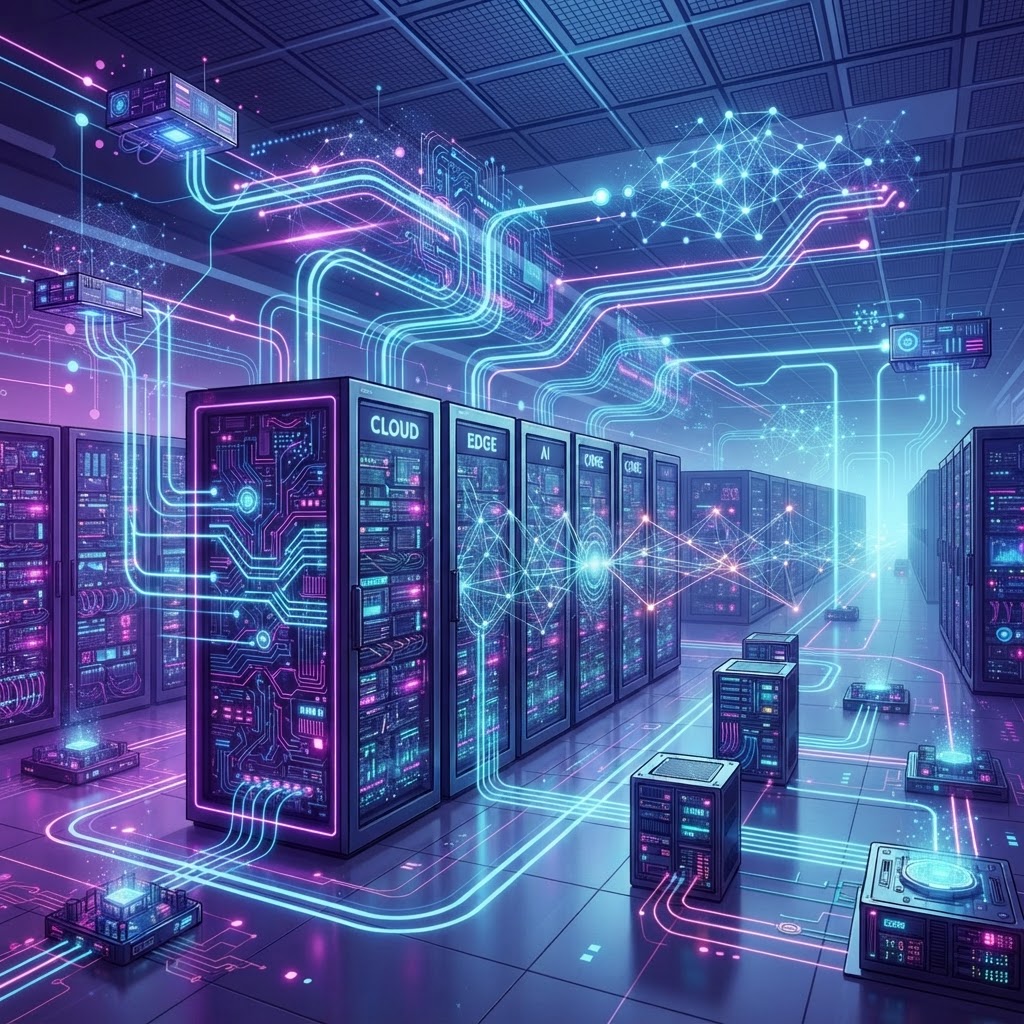
Enterprise technology is undergoing its most significant transformation since the cloud revolution. At the center of this shift are AI agents—autonomous systems that don't just process data but take action, orchestrate infrastructure, and make decisions in real time. From cloud-native architecture and edge computing to AI governance and self-healing systems, the technology trends defining 2025 are all being reshaped by agentic AI. This guide explores the trends that matter and how they're changing enterprise digital infrastructure.
Trend 1: Agentic AI as Enterprise Infrastructure
The most significant technology trend of 2025 is the emergence of agentic AI as core enterprise infrastructure. AI agents are no longer experimental—they're production systems that manage customer support, process transactions, optimize supply chains, and even manage other AI systems. The enterprise suite is being reimagined around autonomous agents that handle end-to-end workflows.
What makes this trend transformative is the shift from AI as a tool to AI as a worker. Traditional AI required humans to interpret outputs and take action. Agentic AI takes action directly—an AI agent can detect a system anomaly, diagnose the root cause, apply a fix, verify the resolution, and document the incident—all without human intervention. This autonomy is what separates the current wave of enterprise AI from everything that came before.
Trend 2: Cloud-Native Architecture Meets AI Orchestration
Cloud-native architecture—containerized microservices, serverless functions, and Kubernetes orchestration—has become the standard for enterprise applications. In 2025, AI agents are taking over the orchestration layer. Instead of DevOps engineers manually configuring deployments, scaling rules, and failover policies, AI agents manage these operations autonomously.
This AI-driven orchestration delivers several advantages:
- Predictive scaling: AI agents analyze traffic patterns and scale resources before demand spikes, not after
- Self-healing systems: When a service fails, AI agents automatically reroute traffic, restart services, and apply fixes
- Cost optimization: Agents continuously right-size resources, eliminating over-provisioning and reducing cloud costs by 20-40%
- Intelligent routing: AI agents route requests based on latency, cost, and capacity—not just round-robin load balancing
The Cloud Platform as AI Foundation
Modern cloud platforms are evolving to support AI-native workloads. They provide GPU clusters for model inference, vector databases for semantic search, and managed AI services that abstract away infrastructure complexity. The cloud platform is no longer just compute and storage—it's the foundation for autonomous AI operations, providing the scalability, security, and observability that agentic AI requires.
Trend 3: Edge Computing and AI at the Source
Edge computing is moving AI processing closer to where data is generated—retail stores, factories, vehicles, and IoT devices. This reduces latency, saves bandwidth, and enables real-time decision-making that cloud-only architectures can't support. AI agents at the edge make local decisions while syncing with cloud agents for broader context.
Use cases for edge AI include:
- Retail: In-store AI agents that manage inventory, optimize shelf layouts, and personalize customer experiences in real time
- Manufacturing: Edge AI that monitors equipment health, predicts failures, and adjusts production lines autonomously
- Logistics: AI agents in warehouses that optimize picking routes, manage inventory, and coordinate with autonomous vehicles
- Smart cities: Edge AI that manages traffic, energy, and public safety systems with millisecond response times
Trend 4: Vector Databases and Semantic Infrastructure
Vector databases have emerged as a critical piece of AI infrastructure. Unlike traditional databases that store structured data, vector databases store high-dimensional embeddings—mathematical representations of text, images, and audio that capture semantic meaning. This enables semantic search, recommendation systems, and retrieval-augmented generation (RAG) that powers enterprise AI applications.
For enterprises, vector databases are the bridge between AI models and business data. They enable AI agents to search through millions of documents, product descriptions, or customer records by meaning rather than keywords. A customer searching for "comfortable running shoes for flat feet" gets relevant results even if the product descriptions use different terminology. This semantic understanding is what makes AI-powered search and recommendation feel intelligent rather than mechanical.
Trend 5: AI Governance and Responsible AI Infrastructure
As AI agents take on more autonomous responsibility, AI governance has become a technology trend in its own right. Enterprises need infrastructure that provides audit trails, access control, compliance monitoring, and human-in-the-loop approvals for sensitive actions. AI governance is no longer just a policy concern—it's a technical requirement built into the platform.
Key components of AI governance infrastructure include:
- Audit logging: Every AI agent action is recorded with timestamp, context, and outcome for compliance and debugging
- Access control: Role-based permissions that enforce least-privilege access to tools, data, and systems
- Human-in-the-loop: Approval workflows for high-stakes decisions, with AI agents preparing recommendations for human review
- Compliance frameworks: Built-in support for SOC 2, ISO 27001, HIPAA, GDPR, and industry-specific regulations
- AI observability: Real-time monitoring of agent behavior, performance metrics, and anomaly detection
Trend 6: Low-Code and No-Code AI Development
The democratization of AI development is accelerating. Low-code and no-code platforms now enable business users—not just data scientists and developers—to build and deploy AI agents. This trend is critical because the bottleneck in enterprise AI isn't technology—it's the shortage of specialized talent. By abstracting away the complexity of model training, API integration, and deployment, no-code platforms make agentic AI accessible to every business.
The impact is significant. Organizations using no-code AI platforms deploy agents 5-10x faster than those building from scratch. Business analysts can create AI-powered workflows in days rather than months. And because the platform handles security, compliance, and scalability, business users can focus on use cases rather than infrastructure.
Trend 7: Cybersecurity Transformed by AI
Cybersecurity is being transformed by AI agents that detect, respond to, and prevent threats autonomously. Traditional security tools relied on signature-based detection—identifying known threats. AI-powered security analyzes behavior, detects anomalies, and responds to zero-day threats in real time. The cybersecurity landscape is an arms race, and AI agents are the only way to keep pace with increasingly sophisticated attacks.
AI-driven security infrastructure provides:
- Real-time threat detection: AI agents analyze network traffic, user behavior, and system logs to detect threats in milliseconds
- Autonomous response: When a threat is detected, AI agents can isolate affected systems, block malicious traffic, and alert security teams simultaneously
- Predictive defense: By analyzing attack patterns, AI agents predict and pre-empt future attacks before they occur
- Continuous compliance: AI agents monitor systems for compliance violations and automatically remediate issues
Building Your Enterprise AI Technology Stack
For enterprises looking to adopt these trends, the key is building an integrated technology stack rather than buying point solutions. Here's a framework:
- Start with a cloud-native foundation—containerized, scalable, and ready for AI workloads
- Deploy an agentic AI platform that provides agent orchestration, governance, and observability
- Implement vector databases for semantic search and RAG-powered applications
- Add edge computing for use cases that require real-time, local processing
- Integrate AI governance from day one—audit trails, access control, and compliance frameworks
- Adopt no-code tools to empower business users to build AI workflows
- Layer AI-powered security across the entire stack
The Platform for Enterprise AI
1C Platform integrates these trends into a single platform—agentic AI orchestration, cloud-native architecture, AI governance, vector database integration, and enterprise-grade cybersecurity. The platform's developer tools and SDK make it accessible to both technical teams and business users, while built-in compliance frameworks ensure safe deployment in regulated industries. Whether you're modernizing legacy infrastructure or building new AI-native systems, the platform provides the foundation for autonomous enterprise operations.
People Also Ask
What are the top enterprise technology trends in 2025?
The top enterprise technology trends in 2025 include agentic AI and autonomous agents, cloud-native architecture, edge computing, composable commerce platforms, AI-powered cybersecurity, vector databases for semantic search, and AI governance frameworks. These trends are collectively reshaping how enterprises build, deploy, and manage digital infrastructure.
How are AI agents transforming enterprise technology?
AI agents transform enterprise technology by automating complex multi-step workflows, orchestrating microservices, managing infrastructure autonomously, providing real-time decision-making, and enabling self-healing systems. They reduce operational overhead by 40-70% while improving reliability and scalability.
What is cloud-native architecture in enterprise AI?
Cloud-native architecture in enterprise AI uses containerized microservices, serverless functions, and orchestrated deployment (Kubernetes) to build scalable, resilient AI systems. AI agents manage these components autonomously—scaling resources, handling failures, and optimizing performance without human intervention.
How does edge computing work with AI?
Edge computing with AI processes data closer to where it is generated—IoT devices, retail stores, factories—reducing latency and bandwidth costs. AI agents at the edge make real-time decisions locally while syncing with cloud agents for broader context, enabling use cases like real-time inventory, autonomous vehicles, and smart manufacturing.
Related Articles & Resources
Explore related topics and resources on the 1C Platform.
The Rise of Agentic AI: A Game Changer for Enterprises
Discover how autonomous AI agents are transforming enterprise operations and enabling intelligent de
AI Automation: The Complete Guide to Automating Business with AI
Comprehensive guide to AI automation. Learn how autonomous AI agents automate complex business workflows, reduce costs by 40-70%, and transform enterprise operations.
How AI Is Transforming Ecommerce: From Personalization to Autonomous Operations
Discover how AI and agentic AI are revolutionizing ecommerce—from hyper-personalization and dynamic pricing to autonomous inventory management and AI-driven customer support.
Top 100 Questions: AI, Ecommerce, Digital Commerce & Integration
The 100 most important questions about AI, ecommerce, digital commerce, integration, customer acquisition, tech debt, current adoption, and challenges—with expert answers by Sufi Khan Sulaiman.