
Digital Commerce in 2025: Building AI-Powered Customer Journeys
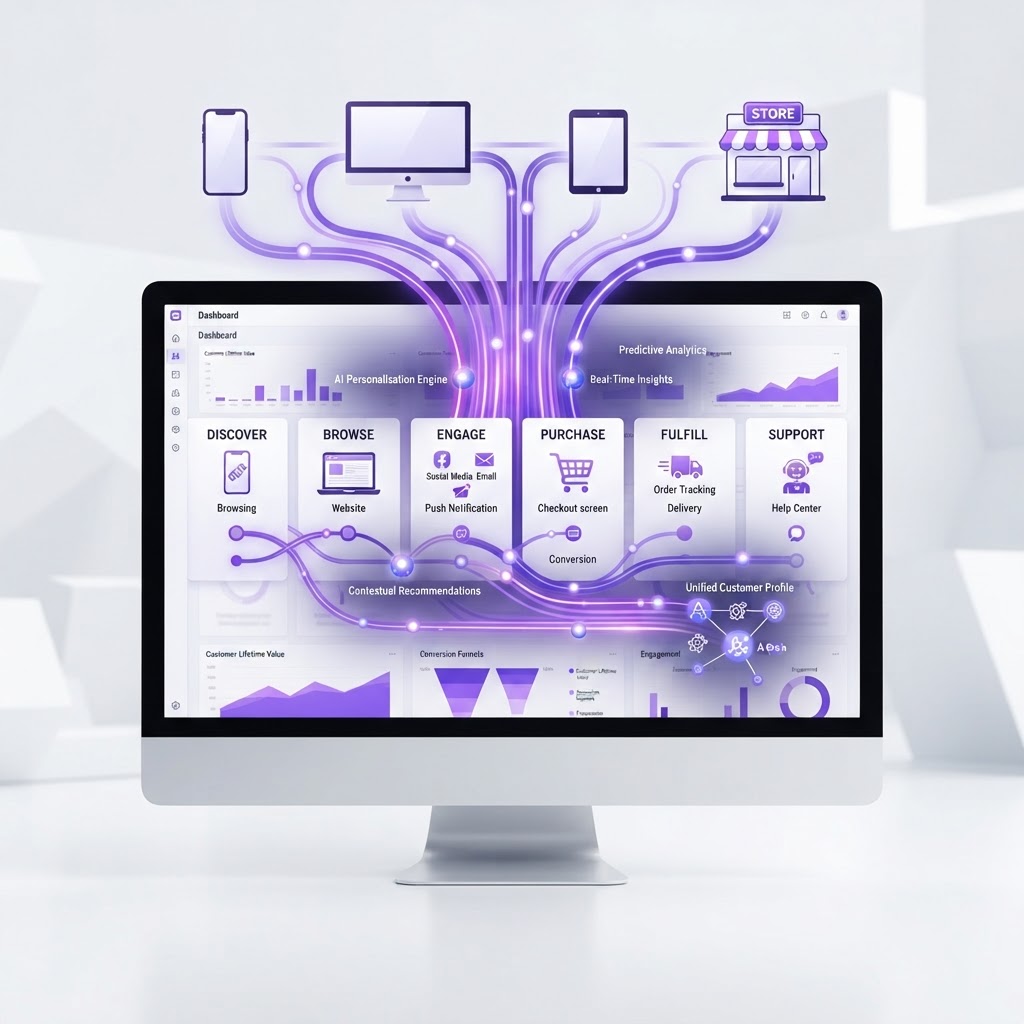
Digital commerce in 2025 bears little resemblance to the online stores of a decade ago. The shift from monolithic ecommerce platforms to composable, headless architecture has unlocked unprecedented flexibility. Combined with agentic AI, businesses can now build customer journeys that adapt in real time—composing personalized experiences from modular components, orchestrating across every channel, and automating the entire commerce lifecycle without human intervention.
The Architecture Revolution: From Monolith to Composable
For years, ecommerce businesses were locked into monolithic platforms—all-in-one suites that handled catalog, cart, checkout, CMS, and search in a single system. While convenient, these platforms created rigid experiences that couldn't adapt to new channels or customer expectations. The composable commerce movement changed this by breaking the monolith into modular components, each best-in-class and independently replaceable.
The real power of composable commerce emerges when AI agents orchestrate these components. Instead of developers hardcoding which components serve which pages, AI agents dynamically compose experiences based on customer context. A first-time visitor might see a search-first experience powered by an AI search component. A returning customer with high lifetime value might see a personalized landing page composed from their purchase history. The AI agent decides which components to assemble, in what order, for each individual customer.
Headless Commerce: The Foundation
Headless commerce decouples the frontend from the backend, allowing businesses to deliver commerce experiences anywhere—web, mobile app, social media, voice assistant, smart watch, even in-store kiosks. The backend commerce engine exposes APIs that any frontend can consume, and AI agents manage the logic that connects them.
This architecture is what makes true omnichannel commerce possible. A customer can browse on mobile, add to cart on desktop, complete checkout via voice assistant, and pick up in-store—all with a consistent, personalized experience because the AI agent maintains context across every touchpoint. The headless backend ensures the same product data, pricing, and inventory are available everywhere, while the AI agent ensures the experience is tailored to each channel and customer.
AI-Powered Customer Journeys
The customer journey is no longer a linear funnel. It's a dynamic, non-linear experience where customers discover products through search, social, influencer recommendations, visual search, and AI-powered chatbots. They research across multiple devices, compare prices in real time, and expect personalized recommendations at every step. AI agents are what make this complexity manageable.
An AI-powered customer journey starts the moment a customer interacts with your brand. The AI agent captures signals—what they searched for, how long they spent on a product page, what they added to cart but didn't buy, what emails they opened. It builds a real-time profile and uses it to personalize every subsequent interaction. If a customer abandons a cart, the agent doesn't just send a generic reminder—it composes a personalized email with the exact products they viewed, a relevant discount based on their price sensitivity, and complementary product recommendations.
Omnichannel Orchestration
Omnichannel commerce means delivering consistent experiences across every channel—but true omnichannel goes beyond consistency. It's about continuity. A customer who starts a conversation with an AI chatbot on your website should be able to continue it on mobile, pick it up via email, and resolve it in-store—all without repeating themselves. AI agents maintain this continuity by storing conversation context, purchase history, and preferences in a shared memory layer accessible across channels.
The results are significant. Businesses with strong omnichannel strategies retain 89% of their customers, compared to 33% for weak omnichannel. Average order value is 30% higher when customers shop across multiple channels. And customer lifetime value increases by 3-5x for omnichannel customers compared to single-channel shoppers.
Conversational Commerce: AI Agents as Shopping Assistants
Conversational commerce is one of the fastest-growing segments of digital commerce. Customers increasingly prefer to interact with brands through messaging—whether that's a chatbot on your website, a voice assistant, WhatsApp, or social media DMs. AI agents power these conversations, understanding natural language, answering product questions, making recommendations, and completing purchases—all within the conversation.
The key difference between early chatbots and today's agentic AI assistants is autonomy. Early chatbots could answer FAQs. Today's AI agents can understand complex queries ("I need a gift for my mother who loves gardening and is allergic to lilies"), search the catalog, recommend products, apply a discount, process the payment, and schedule delivery—all in a single conversation. This level of service, once available only through human concierges, is now scalable to every customer.
The Role of Data in AI-Powered Commerce
Data is the fuel that powers AI-driven digital commerce. Every customer interaction—click, view, search, purchase, return, review—generates data that AI agents use to improve personalization, forecasting, and automation. But data alone isn't enough. The businesses winning in digital commerce have invested in data infrastructure that makes this data accessible, clean, and real-time.
Modern commerce data architectures include:
- Customer Data Platforms (CDPs) that unify customer data from every touchpoint into a single profile
- Real-time event streaming that captures customer actions as they happen, enabling instant personalization
- Product Information Management (PIM) systems that ensure consistent product data across channels
- Vector databases that power semantic search and AI-powered product recommendations
- AI governance frameworks that ensure data is used ethically and in compliance with privacy regulations
Building Your Digital Commerce Strategy
A successful digital commerce strategy in 2025 requires more than technology—it requires a fundamental shift in how you think about customer experience. Here's a framework for building your strategy:
- Map the customer journey across every channel and identify friction points
- Invest in composable architecture—decouple your frontend from your backend commerce engine
- Unify your customer data in a CDP that provides a single view of each customer
- Deploy AI agents for personalization, search, support, and inventory management
- Enable conversational commerce across web, mobile, and messaging channels
- Implement AI governance to ensure ethical, compliant use of customer data
- Measure and optimize continuously—AI agents should be testing and learning autonomously
The Future: Autonomous Commerce
The future of digital commerce is autonomous—AI agents that manage the entire commerce lifecycle without human intervention. From sourcing products and managing inventory to personalizing experiences and handling customer support, autonomous commerce systems will run 24/7, adapting to market conditions, customer behavior, and business goals in real time.
This doesn't mean humans are eliminated from commerce. It means humans focus on strategy, creativity, and relationship-building while AI agents handle the operational complexity. The businesses that embrace this shift will operate at a scale and efficiency that's impossible with traditional approaches. They'll deliver personalized experiences to millions of customers simultaneously, adapt to market changes in real time, and grow without the operational constraints that have historically limited digital commerce.
The Platform for Autonomous Commerce
1C Platform provides the foundation for autonomous digital commerce—agentic AI that orchestrates composable commerce components, AI governance for ethical operations, and enterprise-grade security for regulated environments. Whether you're modernizing a legacy ecommerce platform or building a new digital commerce business from scratch, the platform's autonomous agents handle the complexity so you can focus on growth.
People Also Ask
What is digital commerce?
Digital commerce is the end-to-end process of selling products and services through digital channels. It encompasses ecommerce, mobile commerce, social commerce, voice commerce, and the underlying technology—payments, fulfillment, customer experience, and data—that makes online selling possible.
What is headless commerce?
Headless commerce is an architecture where the frontend presentation layer is decoupled from the backend commerce engine. This allows businesses to deliver consistent experiences across web, mobile, social, voice, and IoT channels while AI agents orchestrate the backend logic independently.
What is composable commerce?
Composable commerce is an approach where businesses assemble best-of-breed commerce capabilities—cart, checkout, search, CMS, PIM—as modular components. AI agents orchestrate these components dynamically, composing and recombining them to deliver personalized experiences for each customer.
How does AI power omnichannel commerce?
AI powers omnichannel commerce by maintaining customer context across every channel—web, mobile, social, voice, in-store. AI agents store conversation history, purchase data, and preferences in a shared memory layer, ensuring customers can start on one channel and continue on another without repeating themselves. Businesses with strong omnichannel retain 89% of customers.
Related Articles & Resources
Explore related topics and resources on the 1C Platform.
How AI Is Transforming Ecommerce: From Personalization to Autonomous Operations
Discover how AI and agentic AI are revolutionizing ecommerce—from hyper-personalization and dynamic pricing to autonomous inventory management and AI-driven customer support.
AI Automation: The Complete Guide to Automating Business with AI
Comprehensive guide to AI automation. Learn how autonomous AI agents automate complex business workflows, reduce costs by 40-70%, and transform enterprise operations.
The Rise of Agentic AI: A Game Changer for Enterprises
Discover how autonomous AI agents are transforming enterprise operations and enabling intelligent de
Top 100 Questions: AI, Ecommerce, Digital Commerce & Integration
The 100 most important questions about AI, ecommerce, digital commerce, integration, customer acquisition, tech debt, current adoption, and challenges—with expert answers by Sufi Khan Sulaiman.